
Should You Keep Application and Infrastructure Code in the Same Repository? A DevOps Perspective


As a senior DevOps engineer, I’ve often grappled with the question: Should application code and infrastructure code reside in the same repository? It’s a topic that stirs much debate in the DevOps community. In this blog post, I’ll share my insights on the pros and cons of each approach, factors to consider, best practices, and real-world examples – with repository structures and diagrams – to help you make an informed decision for your projects.
Introduction
In the DevOps world, version control systems are the backbone of collaboration and efficiency. How we organize our repositories can significantly impact our workflows, security, and deployment processes. The decision to keep application and infrastructure code together or separate isn’t one-size-fits-all; it depends on your team’s needs, project complexity, and organizational policies.
The Case for a Single Repository
If the infrastructure is only specific to your application, then I would place it in the application-specific repo since the infra will only work for the application. Doing it this way would result in a much cleaner design, deleting the app would ideally also remove the infra tied to the app. Tight coupling between the app and dev would be apt in this case.
Pros
Synchronized Changes: Keeping both codes in one repository ensures that changes to the application are in lockstep with infrastructure updates. This tight coupling can reduce deployment errors due to mismatched versions.
Simplified CI/CD Pipelines: A unified repository streamlines your Continuous Integration/Continuous Deployment (CI/CD) processes. With all code in one place, setting up automated pipelines becomes more straightforward.
Atomic Commits: Developers can make atomic commits that include both application and infrastructure changes. This practice makes it easier to track related updates and roll back if necessary.
Easier Onboarding: New team members have a single source of truth, simplifying the onboarding process and reducing the learning curve.
Consistent Versioning: Tagging releases becomes more cohesive, ensuring that both application and infrastructure changes are deployed together.
Cons
Repository Bloat: Combining both codes can make the repository large and unwieldy, affecting performance and developer productivity.
2. Access Control Challenges: If you need to restrict access to sensitive infrastructure code, a single repository complicates permission management.
3. Blurred Separation of Concerns: Mixing infrastructure and application code can lead to confusion and accidental changes by team members who aren’t familiar with both domains.
4. Differing Lifecycles: Application code often changes more frequently than infrastructure code. A single repository doesn’t accommodate these differing update cycles well.
Example Repository Structure
When using a single repository for both application and infrastructure code, it’s crucial to organize your files clearly to prevent confusion. Here’s an example of how you might structure your repository:
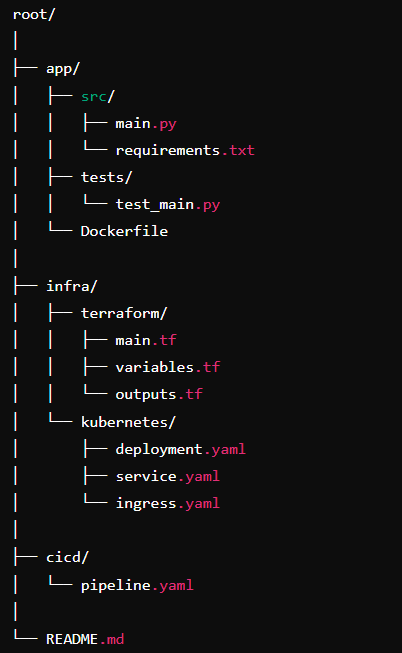
In this structure:
app/ contains the application code.
infra/ holds the infrastructure-as-code files, such as Terraform and k8s manifests.
ci-cd/ includes CI/CD pipeline configurations, like GitHub Actions workflows.
The Case for Separate Repositories for app and infra
Pros
Clear Separation of Concerns: Distinct repositories enforce boundaries between application development and infrastructure management, promoting better code organization.
2. Enhanced Security: You can apply granular access controls, protecting sensitive infrastructure configurations and secrets.
3. Independent Lifecycles: Infrastructure and application code can evolve and be versioned independently, accommodating different development paces.
4. Repository Size Management: Smaller, focused repositories are easier to manage and improve performance.
5. Modularity and Reusability: Infrastructure code can be reused across multiple projects, fostering modularity and reducing duplication.
Cons
Complex CI/CD Pipelines: Managing multiple repositories adds complexity to your deployment processes, requiring more sophisticated tooling.
2. Synchronization Overhead: Keeping application and infrastructure changes in sync requires careful coordination and can introduce integration challenges.
3. Increased Onboarding Effort: New team members must familiarize themselves with multiple repositories, which can be time-consuming.
4. Cross-Team Communication: Separate repositories may necessitate more communication between teams, potentially slowing down development cycles.
Example Repository Structures for separate repo for app and infra
When keeping application and infrastructure code in separate repositories, each can be organized independently. Here’s how you might structure them:
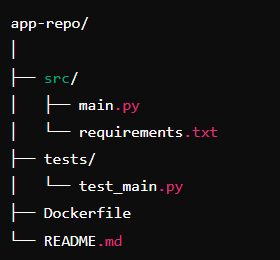
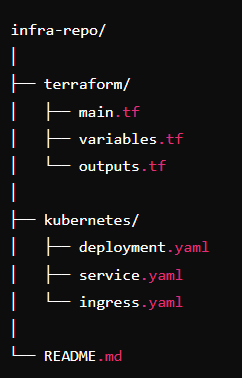
In this setup:
Changes to the
app-reporepository triggers the application build and test processes.The
infra-reporepository can be triggered separately or integrated into the deployment pipeline, ensuring that the infrastructure is up-to-date before deploying the application.Even though the codebases are in separate repositories, you can integrate them in your CI/CD pipelines.
Key Factors to Consider
1. Team Structure
Unified Team: If the same team handles both application and infrastructure, a single repository might enhance collaboration.
Separate Teams: Distinct repositories can help maintain clear responsibilities and reduce accidental interference between teams.
2. Project Complexity
Small Projects: A single repository might suffice, simplifying management.
Large Projects: Complex projects may benefit from separation to handle the codebases effectively.
3. Deployment Frequency
Frequent Deployments: If your application code changes often, separating repositories can prevent unnecessary redeployment of infrastructure code.
Synchronized Deployments: For changes that frequently impact both application and infrastructure, a single repository ensures they are deployed together.
4. Security and Compliance
Regulatory Requirements: Compliance standards may necessitate stricter control over infrastructure code.
Sensitive Information: Separate repositories can better protect secrets and sensitive configurations.
5. Tooling and Automation
CI/CD Capabilities: Evaluate whether your tools can efficiently handle multiple repositories.
Version Control Practices: Ensure your workflows support cross-repository dependencies if you opt for separation.
Best Practices
If Using a Single Repository
Organize Your Directory Structure: Clearly separate application and infrastructure code within the repository to prevent confusion.
2. Implement Access Controls: Use branch protection and code ownership rules to manage permissions effectively.
3. Automated Testing: Include tests that cover both application and infrastructure changes to catch issues early.
4. Use Feature Branches: Leverage Git branching strategies to manage concurrent development efforts without stepping on each other’s toes.
If Using Separate Repositories
Version Synchronization: Adopt a tagging or versioning system to align application versions with compatible infrastructure configurations.
2. Automate Your Pipelines: Configure CI/CD pipelines to handle cross-repository dependencies, ensuring coordinated deployments.
3. Comprehensive Documentation: Maintain clear documentation on how repositories interact, including setup instructions and dependency management.
4. Cross-Repository Communication: Use webhooks or pipeline triggers to initiate actions across repositories when changes occur.
Conclusion
The choice between a single repository and separate repositories for application and infrastructure code isn’t straightforward. It hinges on various factors like team dynamics, project complexity, and security requirements.
When to Choose a Single Repository
Small Teams: Where members handle both application and infrastructure code.
Tightly Coupled Changes: Projects where changes to application and infrastructure are closely related.
Simplified Onboarding: When you want to minimize the complexity for new team members.
When to Choose Separate Repositories
Distinct Teams: Organizations with separate development and operations teams.
Security Needs: Projects requiring stringent security measures for infrastructure code.
Complex Systems: Applications where independent versioning and deployment are beneficial.
Remember, flexibility is key. As your project evolves, you might find that your initial choice needs reevaluation.